DOPA LABS, APPLICATIONS
What robotics teams build with these environments.
Six workflows where simulation-ready environments directly support robot development, training, testing, and validation, not abstract use cases.
DOPA LABS delivers simulation-ready environments for robotics, validated for NVIDIA Isaac Sim.
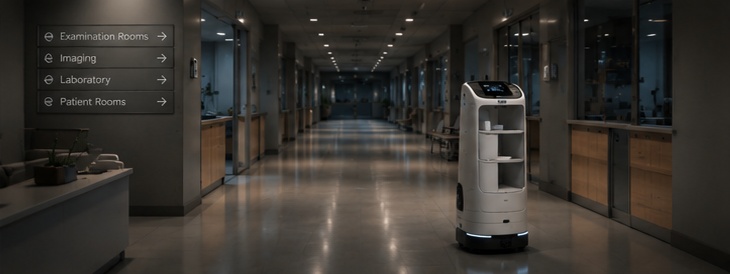
Navigation and service robotics in a structured indoor space
Application Areas
Where these environments fit into robot development.
Each application area depends on a different property of the environment. That's why structure, labels, and physics are treated as first-class parts of every environment we deliver, not optional detail.
Navigation
Workflow
Path planning and obstacle avoidance across corridors, doorways, and open floor areas.
Why It Matters
Navigation policies trained without accurate collision geometry and real-world clearances fail to transfer to actual layouts.
What We Provide
Environments with real-world scale, labeled navigable surfaces, and validated clearances for Isaac Sim.
Manipulation
Workflow
Grasping, placing, and interacting with objects on shelves, tables, and equipment interfaces.
Why It Matters
Manipulation depends on accurate object geometry, mass, and collision response. Visual-only assets don't behave correctly under contact.
What We Provide
Physics-aware assets with defined mass, friction, and collision geometry for every object a robot may interact with.
Object Detection
Workflow
Perception models trained to recognize and localize objects and surfaces within a scene.
Why It Matters
Detection models need consistently labeled data across many scene variations, not a single polished render.
What We Provide
Semantic labels on every object and surface, with controlled variation across lighting, placement, and material.
Humanoid Robotics
Workflow
Whole-body locomotion, balance, and interaction tasks that depend on human-scale environments.
Why It Matters
Humanoid platforms are sensitive to floor surface accuracy and obstacle clearance. Small inaccuracies compound across full-body motion.
What We Provide
Environments modeled to human-scale tolerances, with validated floor and obstacle geometry for locomotion testing.
Service Robotics
Workflow
Delivery, wayfinding, and task execution in shared spaces, offices, hospitality venues, retail floors.
Why It Matters
Service robots operate in spaces designed for people, not robots. Testing requires real layouts, not simplified test courses.
What We Provide
Environments modeled on real indoor categories, with the structure and labels service workflows depend on.
Synthetic Data
Workflow
Generating training data for perception and planning models where real-world data collection is limited or costly.
Why It Matters
Synthetic data is only useful if the environment generating it is physically and semantically accurate, otherwise models learn patterns that don't hold in the real world.
What We Provide
Environments with controlled environment variation, built on the same validated structure as every environment we deliver.
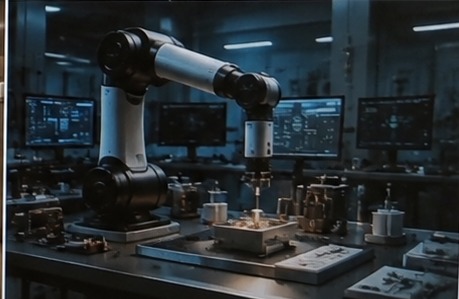
Manipulation depends on what's actually in the scene.
A robotic arm working at a bench needs more than open floor space. It needs interactive objects, articulated elements, and physical properties placed the way they'd actually appear, not idealized for a demo.
Which of these matches your current workflow?
Tell us what your team is building. We'll help you figure out what environment setup supports it.